Why Open Source Makes Sense for Plant Growing
Discover why open-source grow automation saves money, offers hardware freedom, and builds a supportive community of growers worldwide.
Why Open Source Makes Sense for Plant Growing
When it comes to automating your grow room, you face a fundamental choice: lock yourself into a proprietary system or embrace the freedom of open source. For serious growers who want full control over their environment, their data, and their hardware, open source is not just the smarter choice – it's the only choice that makes long-term sense.
The Real Cost of Proprietary Grow Automation
Let's talk numbers first, because the price difference is staggering.
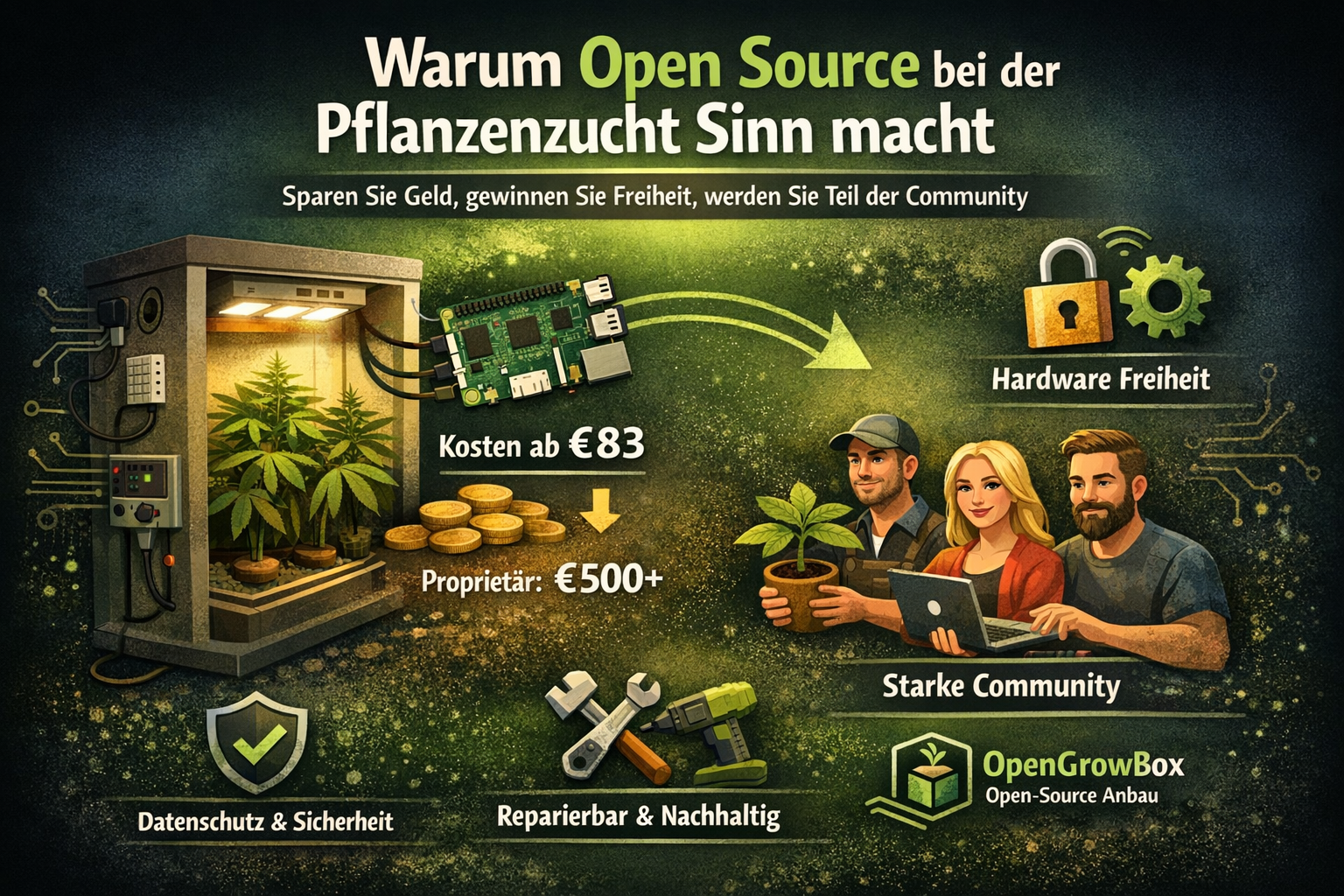
A typical commercial grow automation system – think proprietary controllers, brand-locked sensors, and cloud-dependent software – can easily run you €500 to €1,500 or more just for the initial setup. And that's before you factor in monthly subscription fees, locked premium features, and mandatory hardware upgrades every few years.
With an open-source setup built around Home Assistant and OpenGrowBox, the hardware cost looks completely different:
- Controller (Old PC/ MiniServer or Raspberry Pi): €0–€100
- Temperature & humidity sensor (SHT31, AHT20): €5–€15
- Relay board or smart plugs: €15–€30
- Power supply, cables, enclosure: €20–€30
- Total hardware cost: €50–€180
That's 6–12x cheaper than proprietary alternatives. The money you save goes directly back into what actually matters – better grow lights, premium nutrients, a larger tent, or simply more plants.
Pro Tip: Start with a single sensor and one smart plug. Get comfortable with the system, then scale up gradually. Open source grows with you.
Hardware Freedom: Your Grow, Your Rules
Proprietary systems are built around one goal: keeping you inside their ecosystem. Want to add a sensor from a different manufacturer? Better check their compatibility list. Need to adjust a control parameter that isn't exposed in their app? You're out of luck.
Open source flips this model entirely. With OpenGrowBox and Home Assistant, you can connect virtually any sensor or device that exists – Zigbee, Z-Wave, ESPHome, Tasmota, MQTT, Bluetooth, and more. If Home Assistant supports it, OpenGrowBox can use it.
- Experiment freely: Test new sensor types, new control strategies, and new hardware without asking anyone's permission
- Mix and match: Combine a cheap Xiaomi humidity sensor with a high-end CO₂ module – whatever fits your budget and goals
- Repair, don't replace: A broken €10 sensor is replaced in an afternoon. A broken proprietary controller means waiting for their support team and paying their prices
This freedom is not just convenient – it fundamentally changes how you approach your grow. You stop being a consumer of a system and start being the engineer of your own setup.
Open Source Unlocks Knowledge That Proprietary Systems Hide
This is something that rarely gets talked about, but it matters enormously for the future of indoor cultivation.
Proprietary grow automation companies employ engineers who develop algorithms, control logics, and cultivation methods – and then lock all of that knowledge behind closed doors. Their PID tuning parameters, their VPD calculation methods, their climate response curves: all of it is protected, hidden, and unavailable to you or anyone else.
This is genuinely bad for the growing community as a whole. Breakthroughs in cultivation science get siloed inside corporate IP. Growers can't learn from the logic driving their own systems. Innovations that could benefit thousands of hobbyists and small-scale cultivators never reach them because there's no business incentive to share.
Open source changes this completely. Every algorithm OpenGrowBox uses – every PID controller parameter, every VPD formula, every automation logic – is publicly readable, auditable, and improvable. When a grower with an engineering background finds a better way to model vapor pressure deficit at high temperatures, they can contribute it. When a researcher identifies a more efficient climate response curve, the entire community benefits immediately.
This is how real scientific progress works. And it's only possible when the code is open.
- Transparent logic: Understand exactly why your exhaust fan turns on at a specific moment
- Community-driven improvements: Features are built because growers need them, not because they generate subscription revenue
- Collective intelligence: Thousands of growers contributing real-world data and insights to improve the same system
- No black boxes: Every decision the system makes can be examined, challenged, and improved
Community & Collaboration: Growers Helping Growers
The open-source grow automation community is one of the most knowledgeable and generous communities in the hobby. On GitHub, Reddit, the Home Assistant forums, and Discord servers, experienced growers share their configurations, troubleshoot each other's setups, and collectively push the state of the art forward.
No vendor lock-in means your configurations, automations, and data belong to you. You can share your full setup with another grower halfway across the world. You can migrate your entire system to new hardware without losing anything. You can build on someone else's work and give something back.
Compare this to proprietary systems where your data lives on their servers, your settings are tied to their app, and the community of users is fragmented across different platforms with no shared foundation.
OpenGrowBox vs. Commercial Systems: A Direct Comparison
Let's be specific about what you're actually getting and giving up with commercial grow automation systems.
Hidden costs in proprietary systems:
- Advanced automations locked behind higher pricing tiers
- Mandatory hardware purchases to access new features
- No control if the company shuts down or discontinues the product
- Your data stored on third-party servers you don't control
What OpenGrowBox gives you for free, permanently:
- Full climate automation (temperature, humidity, VPD, CO₂)
- Intelligent light scheduling with day/night differentiation
- Multi-room support with independent control per room
- PID and MPC control modes for precision growers
- Local data storage – no cloud dependency, no subscription needed
- Active development driven by real grower feedback
OpenGrowBox provides these features for free, forever. You own your hardware, you control your data, and you will never pay a subscription fee to run a basic automation that keeps your plants alive.
Security & Privacy: Your Grow Data Belongs to You
This point is increasingly important and often overlooked.
Your grow room data is sensitive. It reveals your location, your setup, your schedules, and potentially the nature of what you're cultivating. With proprietary cloud-connected systems, all of this data passes through servers you have no control over, under privacy policies that can change at any time.
Open-source, locally hosted systems like OpenGrowBox keep everything on your own hardware. Nothing leaves your network unless you explicitly choose to enable remote access. The code that handles your data is fully auditable – any security researcher or technically capable grower can read it, identify vulnerabilities, and report or fix them.
- Local-first: All data stays on your hardware by default
- Auditable code: Anyone can verify how your data is handled
- No third-party dependencies: Your automation runs even if the internet goes down
- Community security review: Open code gets more eyes on it – and vulnerabilities get found and fixed faster
Sustainability: Build a Grow System That Lasts
Proprietary hardware has a planned lifespan. Companies discontinue products, end software support, and shut down cloud services. When that happens, your €1,000 investment becomes a paperweight.
Open-source hardware and software doesn't work that way. An ESP32 running ESPHome will still work in ten years. Home Assistant will still be maintained. OpenGrowBox configurations you write today will still be valid in the future. And if a specific component breaks, you replace just that part – not the entire system.
- Repairability: Replace individual components, not entire systems
- Modularity: Add, remove, and swap components freely
- Longevity: No planned obsolescence, no forced upgrades
- Community continuity: Open-source projects outlive any single company
Conclusion: Open Source Is the Future of Grow Automation
The case for open-source grow automation goes far beyond cost savings, though those savings alone are compelling. It's about owning your system, understanding how it works, contributing to a community that makes it better, and ensuring that the knowledge driving your cultivation is transparent and improvable rather than locked away for profit.
Every grower who switches to open source makes the community smarter. Every bug report, every shared configuration, every contributed improvement raises the ceiling for everyone.
Ready to start? Check out our step-by-step Home Assistant setup guide and build your own open-source grow automation system today. Join thousands of growers who have taken back control of their cultivation – and never looked back.
Related Articles
No related articles found.